
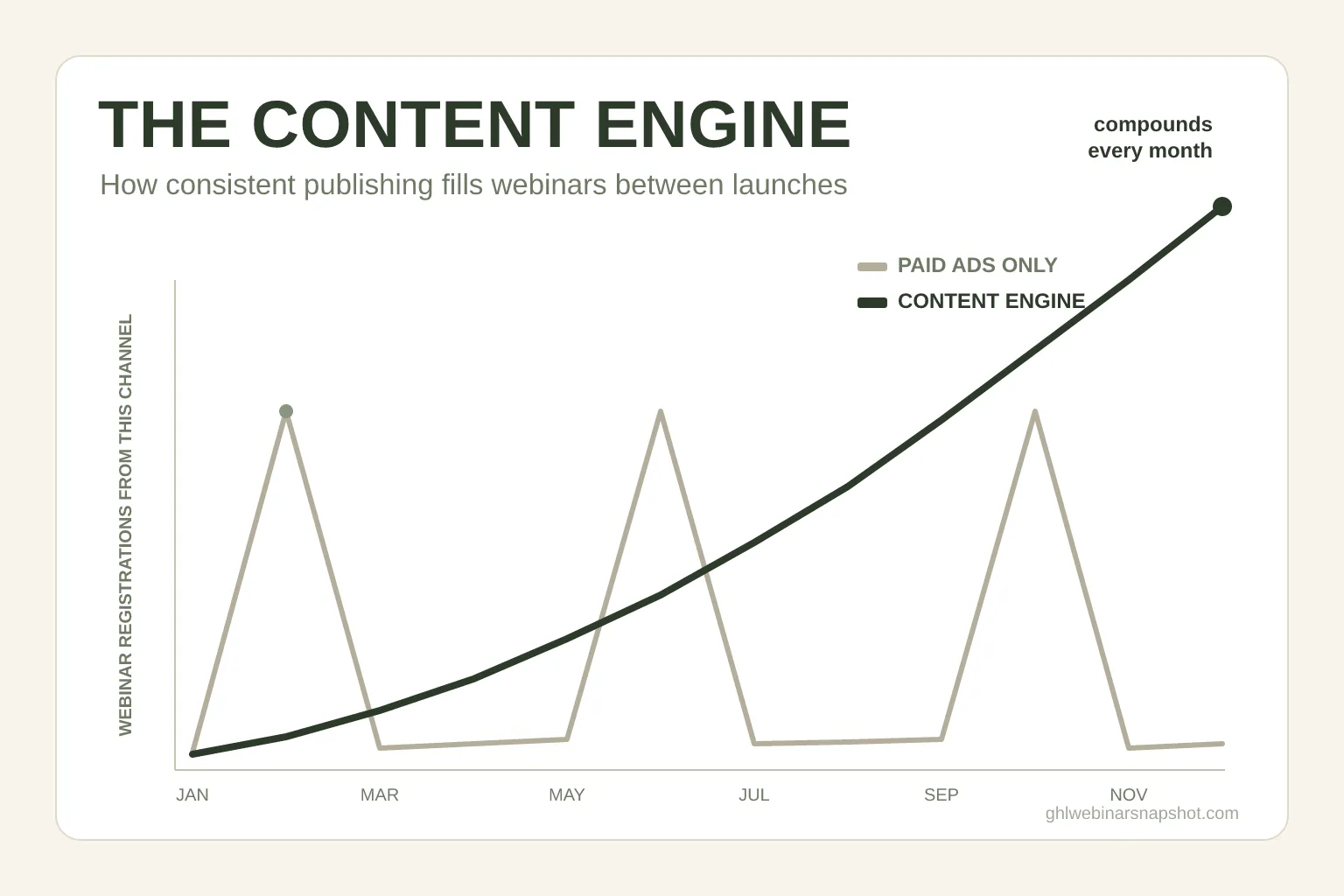
A content engine is a system for publishing consistent, research-based articles on the exact questions your webinar audience is searching — so that between paid launches, when your ads are dark, organic visitors keep finding you, registering, and filling seats on autopilot. For a coach, course creator, or B2B founder who only gets registrations when the ad budget is running, that’s the difference between a pipeline that spikes and collapses and one that compounds every single month. Ads rent attention; the day you stop paying, the traffic stops. Content is an asset that keeps working — and the data on how much it works is stronger than most operators realize.
This is the case for treating content like an engine, not a hobby: what the publishing-frequency research actually shows, why organic traffic compounds while paid does not, how AI search changed the math in 2026, and what a real done-for-you content engine looks like versus a pile of thin AI posts. Every figure below is sourced.
Table of contents
- What fills webinars between launches?
- The between-launch problem: why your pipeline goes quiet
- What a “content engine” actually is
- The data: what consistent publishing does
- Content compounds; paid traffic doesn’t
- Why AI search made this non-negotiable in 2026
- Volume, consistency, or quality? Why thin AI posts fail
- What this means for US coaches and course creators
- FAQ
What fills webinars between launches?
Consistent, research-based content is what fills webinar registrations between launches — because it earns organic search traffic that keeps arriving whether or not your ads are running. A paid campaign is a faucet: open it and registrations flow, close it and they stop. Content is a well you dig once that keeps giving water. The two are not interchangeable, and the operators who treat content as an engine rather than an afterthought are the ones whose calendars stay full in the quiet months.
The mistake most webinar businesses make is running their whole pipeline on paid traffic and launches. It works — until the budget pauses, the launch ends, or ad costs spike — and then the room goes quiet. A content engine is the counterweight: a steady stream of articles answering the questions your ideal attendee types into Google and ChatGPT months before they’d ever sit through an hour of training. When they search, you’re the answer. When they’re ready, you already have their trust.
The between-launch problem: why your pipeline goes quiet
The between-launch problem is the predictable collapse in registrations that happens whenever a webinar business turns off its ads — and it’s structural, not a marketing failure. If 100% of your top-of-funnel depends on paid traffic, then 100% of it disappears the moment you stop spending. You’re not building an audience; you’re renting one on a meter.
Here’s why that’s so costly for webinar operators specifically. Your best content — the webinar itself — is a one-time event. Attendance is finite: the average webinar show-up rate sits around 47.7% (Livestorm’s 2026 benchmark), so even a great registration push only ever converts a slice of the people you paid to reach. Between launches, with nothing new drawing strangers in, the top of the funnel narrows to whoever your ads happen to touch that week.
Meanwhile, the buyers you want aren’t waiting for your next ad. Around 90% of B2B buyers begin their journey with an online search (eMarketer), and they typically consume several pieces of content before they ever talk to you. If you’re invisible in that research phase, you’re not in the running — no matter how good your webinar is. This is the same reason show-up rate compounds only when the top of the funnel keeps refilling: a bigger, warmer audience arriving every week is what makes every downstream number bigger.
None of these are our numbers — they’re independent benchmarks, and together they describe a simple truth: the businesses that publish consistently build a traffic base that paid-only competitors never accumulate. A content engine is how you stop starting from zero every launch.
What a “content engine” actually is
A content engine is a repeatable production system — research, write, publish, optimize — that ships high-quality articles on a fixed cadence to a fast, search-ready website, so your organic footprint grows every week instead of in occasional bursts. The word “engine” matters. A one-off blog post is a firework. An engine is the thing that keeps the lights on.
It’s the opposite of how most coaches “do content”: a burst of three posts in January, then silence until a launch reminds them they have a blog. That stop-start pattern never builds momentum, because search rankings and AI citations reward depth and consistency over time, not sporadic effort. A real engine runs whether or not you feel inspired that week.
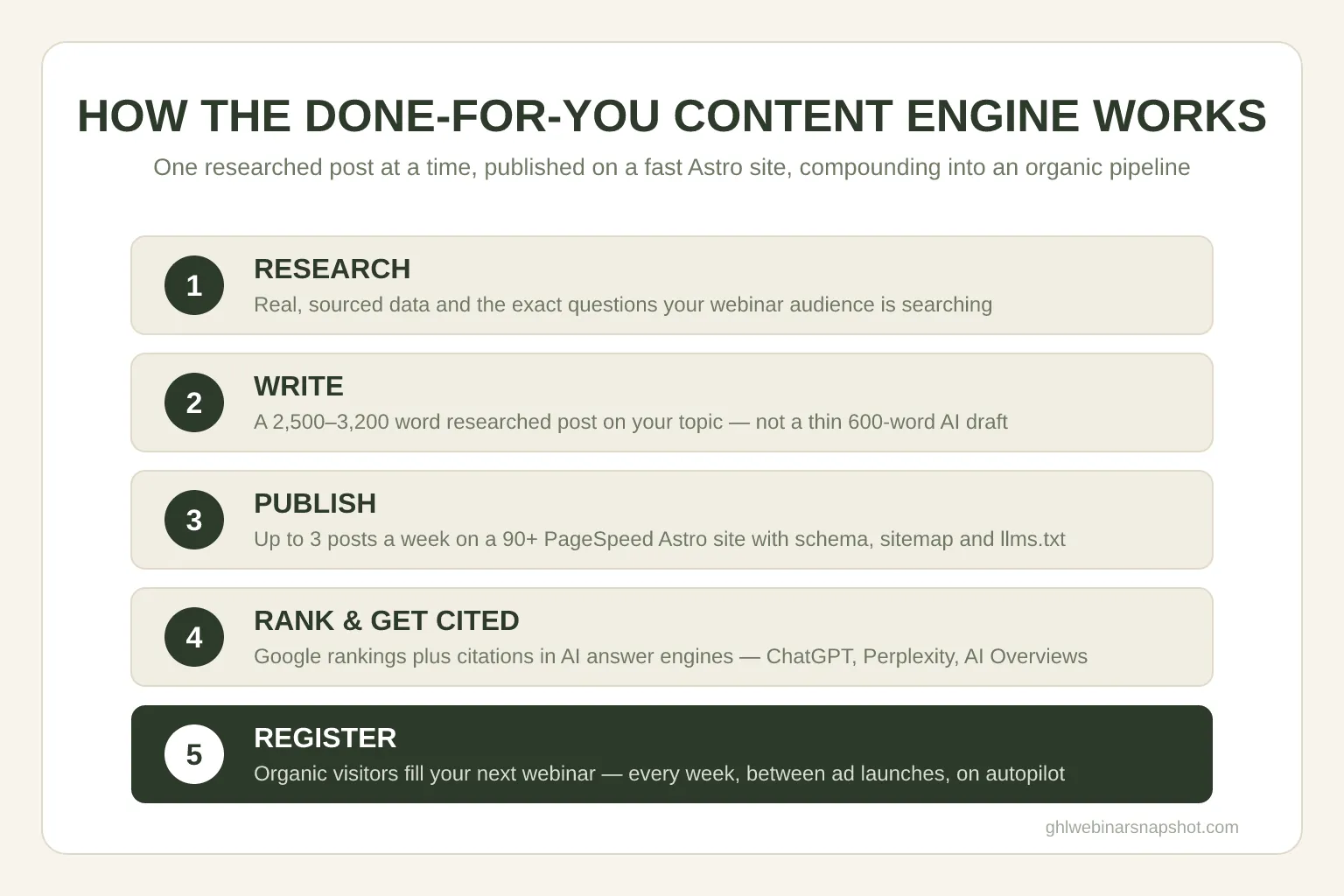
The five moving parts are worth naming, because a weakness in any one breaks the whole thing:
- Research. Real, sourced data and the specific questions your audience is searching — not a topic you guessed at. This is what makes a post citable and trustworthy.
- Write. Genuine depth. The average Google top-10 result runs around 1,447 words (Backlinko’s analysis of 11.8M results — a correlation, not a magic threshold), and thin content is exactly what gets buried.
- Publish. On a fast, technically clean site. Speed and structure decide whether your content is even eligible to rank — which is why we build on a fast Astro registration and content site with schema, sitemaps, and an
llms.txtfor AI crawlers. - Optimize for search and AI. Titles, internal links, structured data, and answer-first passages that both Google and AI answer engines can quote.
- Convert. Every post links to your webinar registration and money pages, so organic readers flow into the same funnel your ads feed.
The data: what consistent publishing does
The publishing-frequency research is unusually consistent: more quality posts, more often, produces disproportionately more traffic and leads — and the effect is strongest for small teams, which is most coaches. HubSpot’s benchmark data found that companies publishing 16 or more posts a month got about 3.5× more traffic and 4.5× more leads than those publishing zero to four. For small companies specifically, publishing 11+ times a month drove roughly 3× the traffic of publishing once or not at all.
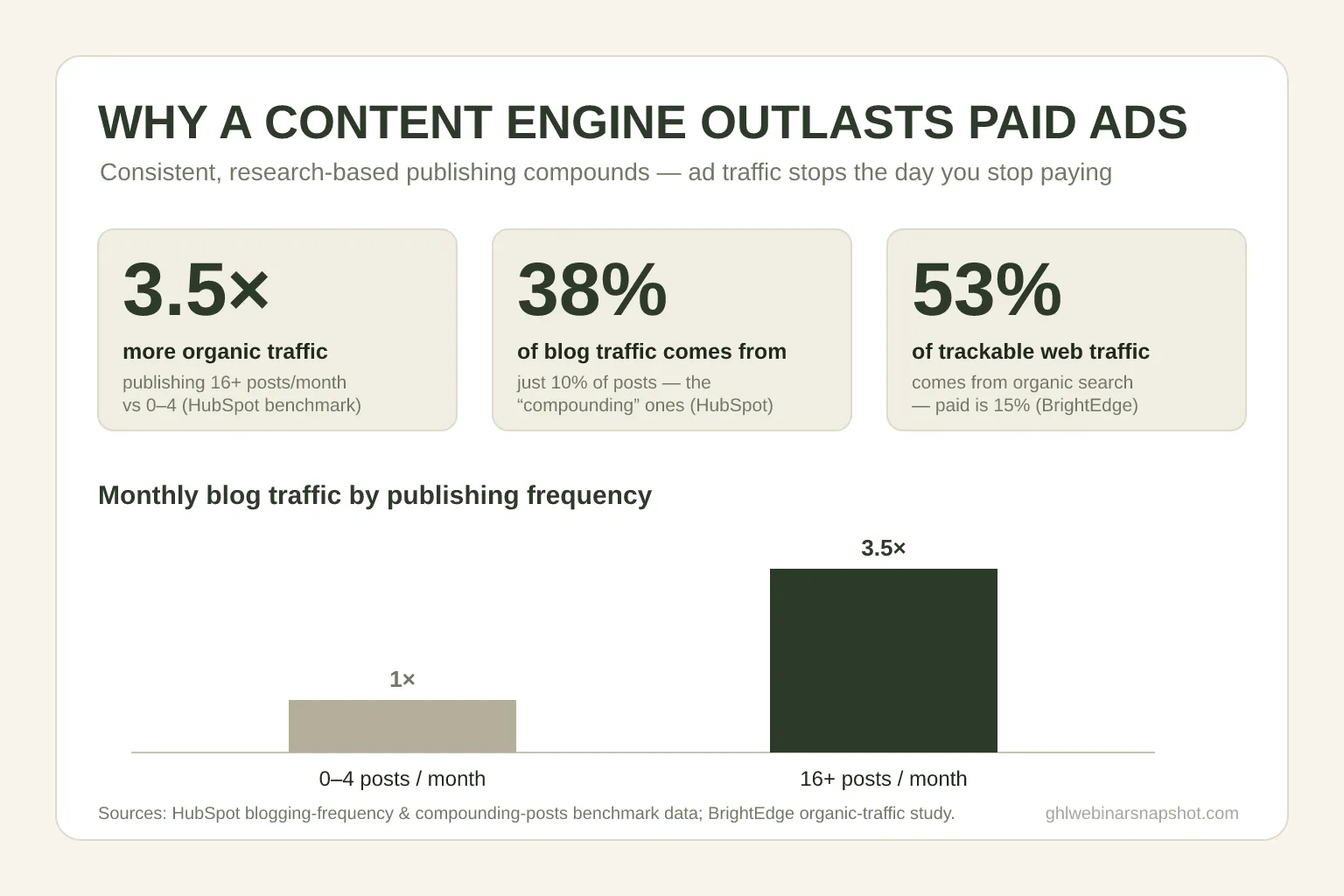
The single most important stat for the between-launch thesis is the compounding one. HubSpot found that a small share of posts — the “compounding” ones that keep earning search traffic long after publication — made up about 10% of posts but drove roughly 38% of all blog traffic. You don’t know in advance which posts those will be, which is exactly why cadence matters: you publish consistently, and a subset become evergreen traffic machines that fill your funnel for years.
And it’s efficient. Content marketing costs about 62% less than traditional outbound marketing while generating roughly 3× as many leads (Demand Metric). For an operator watching ad costs climb every quarter, that ratio is the whole argument.
Content compounds; paid traffic doesn’t
Paid traffic is linear and rented; organic content is compounding and owned — which is why a content engine eventually out-produces an equivalent ad spend, and keeps producing when the ads are off. Search is simply where the volume lives. Organic search accounts for about 53% of all trackable website traffic, versus roughly 15% for paid search, per BrightEdge. You can rent the 15% or build toward the 53%.
The compounding comes from a quirk of how Google ranks. Established, in-depth pages tend to win over time: the average #1-ranking page is about five years old, and 72.9% of top-10 results are three or more years old, per Ahrefs. New content rarely rockets to the top — only about 6.11% of newly published pages reach the top 10 within a year — which sounds discouraging until you flip it: the post you publish today is an asset that keeps appreciating. Every month you delay is a month that asset isn’t aging into authority.
An ad stops the second the budget does. A ranked, cited article keeps sending you registrants for years. That’s the entire reason to start a content engine now rather than “after this launch.”
Why AI search made this non-negotiable in 2026
AI search didn’t kill content marketing — it raised the bar, because now the goal isn’t only to rank on Google but to be the source an AI answer quotes. The behavior shift is real: in 2026, fewer than one-third of Google searches still send a click to the open web (SparkToro), and a Similarweb analysis found roughly 58.5% of U.S. Google searches ended without a click as AI Overviews expanded. People increasingly get their answer on the results page, or from ChatGPT and Perplexity directly.
That sounds like bad news for publishers, and for thin content it is. But it’s good news for depth. AI answer engines don’t invent their answers — they synthesize and cite sources. To be one of those sources, you need exactly what a content engine produces: clear, well-structured, genuinely informative pages with real data and answer-first passages an AI can lift and attribute. Search demand hasn’t vanished; BrightEdge reported organic search volume actually rising year over year even as AI search surged. The traffic is moving toward whoever the models trust.
Volume, consistency, or quality? Why thin AI posts fail
The winning formula is consistency and quality — not one or the other — which is why a firehose of thin, AI-spun 600-word posts fails and a steady cadence of deeply researched articles wins. The temptation, now that anyone can generate a blog post in seconds, is to flood the zone. The data says don’t.
Consider that 96.55% of all pages get zero organic search traffic from Google (Ahrefs’ study of ~14 billion pages). The internet is drowning in content that ranks for nothing and gets cited by nothing. Publishing more of that doesn’t build a pipeline — it builds a graveyard. Even Ahrefs, a company that lives on content, found that nearly half its own posts got little traffic and pruned hundreds of underperformers. Volume without depth is a cost, not an asset.
Here’s the honest comparison for a coach deciding how to run content:
Sporadic / thin content vs. a real content engine
| Feature | A real content engine | Sporadic or thin AI content |
|---|---|---|
| Cadence | Consistent — up to 3 researched posts/week | Bursts around launches, then silence |
| Depth | 2,500–3,200 words, real sourced data | 600-word AI drafts, no sources |
| Ranks over time | Compounds — becomes evergreen traffic | Rarely ranks; joins the 96% with no traffic |
| AI citation-ready | Answer-first, structured, schema | Generic, hard for AI to trust or quote |
| Site speed / SEO base | Fast Astro site, schema, sitemap, llms.txt | Slow page-builder, weak technical base |
| Between-launch pipeline | Fills seats every week on autopilot | Goes quiet the moment ads pause |
The difference isn’t effort for its own sake — it’s whether the work becomes an asset. A researched post that ranks and gets cited pays you back for years. A thin post that never ranks was a cost you’ll never recover. This is the same logic behind repurposing one webinar into weeks of short-form content: do the deep work once, then let it work everywhere.
What this means for US coaches and course creators
For US coaches, course creators, and B2B founders, a content engine is the most durable, lowest-cost way to keep webinars full without endlessly raising ad spend — and it’s the piece almost nobody actually maintains. The reason is simple: writing two or three genuinely researched articles a week, on a fast site, optimized for Google and AI, is a real job. Between running your programs, delivering webinars, and serving clients, it’s the first thing that slips — and the slip is invisible until a launch underperforms because the top of the funnel quietly emptied out.
Content marketing works when it’s maintained, and its payoff is cumulative. That’s why 87% of B2B marketers say content marketing helped them build brand awareness in the last year (Content Marketing Institute) — the ones who keep at it. The operators who win the organic game aren’t more talented writers; they’re more consistent publishers. If you’d rather own that consistency than white-knuckle it, this is exactly the kind of thing to hand to a system.
Running on ads only vs. running a content engine
Registrations spike during launches, then collapse to near-zero. Every new webinar starts from a cold audience. Ad costs climb; the pipeline is only as full as this month's budget.
A steady stream of researched posts ranks and gets cited, so organic visitors register every week — between launches, on autopilot. Each webinar starts from a warmer, growing audience, and ads become an accelerator, not a life-support machine.
That’s the outcome our Get a Website build is designed for. The top tier is literally a Content Engine: a fast, 90+ PageSpeed Astro site plus up to three deeply researched, 2,500–3,200 word posts a week on your topic, each optimized for Google and AI answer engines, with schema, sitemaps, and an llms.txt handled for you — so registration stops being something that only happens when you’re spending. If you want the site and the AI tooling without the full content cadence, the lower tiers cover that too, and our custom software team can wire the whole thing into your webinar funnel.
If you’re mapping the whole funnel and not just the top of it, pair this with our 2026 webinar benchmarks, the webinar conversion funnel breakdown, and the real ROI math on a webinar system. Content fills the top; the automation behind it decides how much becomes revenue.
FAQ
What is a content engine, in plain terms?
A content engine is a repeatable system for publishing consistent, research-based articles on a fixed cadence to a fast, search-ready website. Instead of a burst of posts around each launch, you ship depth-first content every week, so your organic search footprint grows continuously and keeps sending you webinar registrations even when your ads are off.
How often should a coach publish to see results?
Consistency beats occasional bursts, and frequency compounds. HubSpot's benchmark data found companies publishing 16+ posts a month got about 3.5x more traffic and 4.5x more leads than those publishing 0–4, and for small teams, 11+ posts a month drove roughly 3x the traffic of publishing once. The exact number matters less than never stopping — a steady two to three researched posts a week, maintained for months, is what builds a compounding pipeline.
Does blogging still work now that AI search answers everything?
Yes — but the bar is higher. In 2026, fewer than a third of Google searches send a click to the open web (SparkToro), because AI Overviews and assistants answer on the page. But those AI answers are synthesized from sources and cite them, so the goal shifts to being the source an AI quotes. That rewards deep, well-structured, answer-first content and punishes thin filler. Organic search volume is still rising year over year (BrightEdge); the traffic is just consolidating around trusted sources.
Isn't it easier to just generate a lot of AI blog posts?
Flooding your site with thin, unsourced AI posts usually backfires. About 96.55% of all pages get zero organic traffic from Google (Ahrefs), and thin content is exactly what lands in that bucket — it ranks for nothing and gets cited by nothing. The average top-10 result is around 1,447 words of genuine depth (Backlinko). A content engine uses AI as a tool inside a research-first process, not as a replacement for the research; the output is deep, sourced, and built to rank and be cited.
How is a content engine different from paid ads?
Paid ads are rented and linear: registrations flow while you pay and stop the moment you don't. Content is owned and compounding: organic search drives about 53% of trackable web traffic vs 15% for paid (BrightEdge), and roughly 10% of posts — the compounding ones — generate about 38% of a blog's traffic for years (HubSpot). Ads are best as an accelerator on top of a content base, not as your only source of top-of-funnel.
What does the done-for-you Content Engine include?
Our Get a Website Content Engine tier includes a fast, 90+ PageSpeed Astro site plus up to three deeply researched, 2,500–3,200 word posts a week on your topic, each optimized for Google and AI answer engines with schema, sitemaps, and an llms.txt handled for you, on managed Cloudflare hosting. Lower tiers cover the site and AI tooling with a lighter content cadence. Book a call and we'll scope the right tier for where your webinar funnel is now.
About the author
Priya Shankar is a Course Launch & Conversion Coach based in Seattle, WA. She works with course creators and founders who teach to sell — masterclasses, demos, and high-ticket coaching webinars — and came up through online education and content marketing. She thinks as much about the offer and the room energy as the systems underneath it, and writes about connecting the human side of a live event to the content and automation that fill it.
Related reading
- Webinar Benchmarks 2026: Show-Up Rates & Conversion Data
- Why Show-Up Rate Is the Only Webinar Metric That Actually Compounds
- The Webinar Conversion Funnel: From Click to Booked Call
- Can GoHighLevel Websites Rank on Google? A 2026 Guide
- Local SEO & AI Search for Webinar Businesses
- Webinar Landing Page Speed: Astro vs WordPress vs Wix
Sources
- HubSpot — Blogging frequency benchmarks (traffic & leads by posts/month)
- HubSpot — Compounding blog posts (10% of posts, ~38% of traffic)
- Demand Metric — Content marketing costs ~62% less, ~3× the leads
- BrightEdge via Search Engine Land — Organic = 53% of trackable traffic
- Ahrefs — 96.55% of pages get no organic search traffic
- Ahrefs — How long it takes to rank / age of top-ranking pages
- Ahrefs — Blogging statistics (content pruning)
- Backlinko — Search engine ranking factors (avg top-10 word count)
- SparkToro — In 2026, less than one-third of Google searches send a click
- Search Engine Land — 2026 zero-click search study (Similarweb)
- BrightEdge — AI search visits surging in 2025
- eMarketer — B2B buyers still start their research with search
- Content Marketing Institute — B2B Content Marketing Trends
- Livestorm — Webinar Benchmark Report 2026