
You watch the live attendee count as you present. At minute 20 it reads 180: chat moving, hands up, people nodding on camera. Then you say “so here is what I have put together for you,” share the offer slide, and over four minutes the number slides to 118, then 94 by the time you reach the price. The people you spent an hour warming up left in the window where they were supposed to buy.
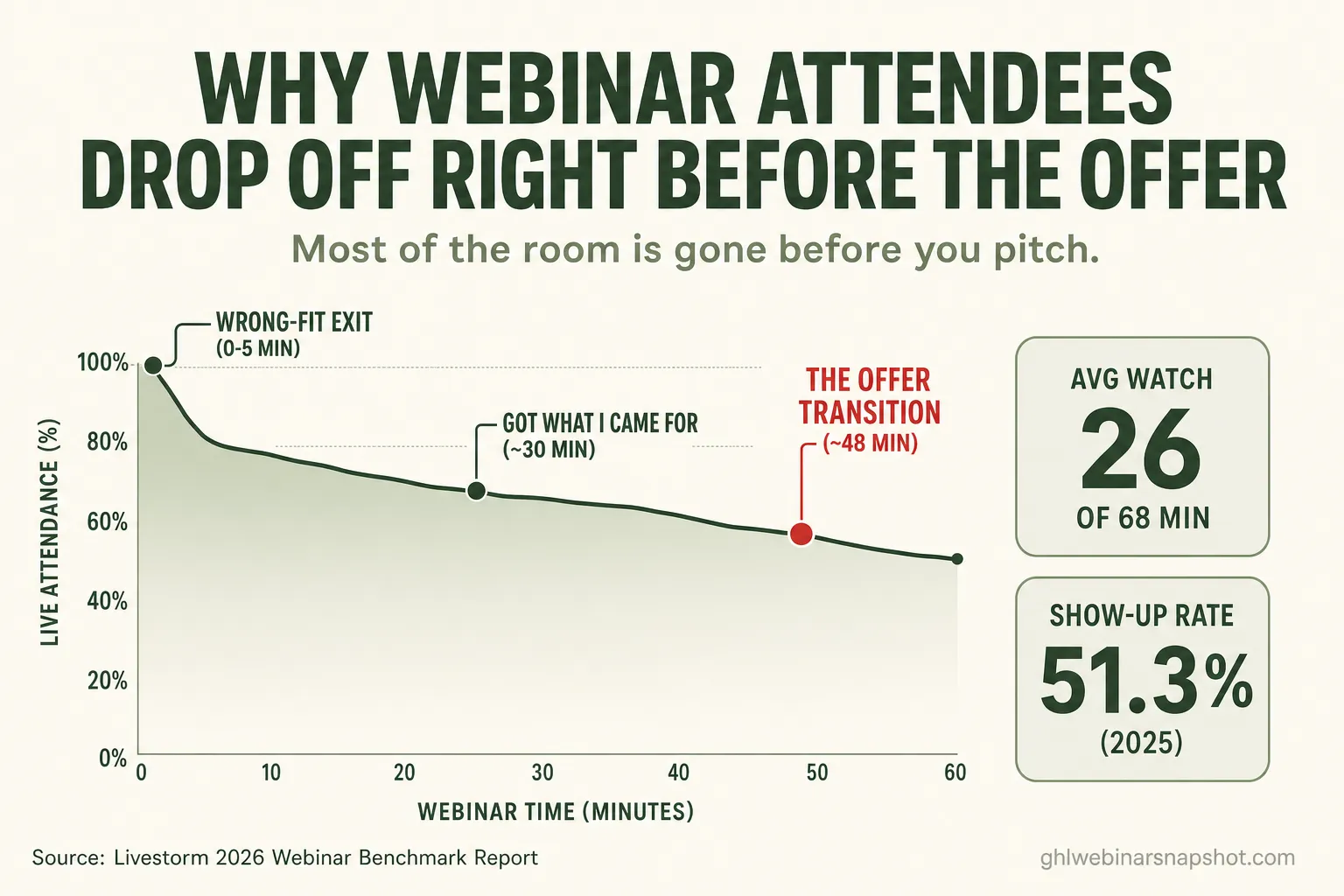
The short version: they did not leave because your offer is bad. They left because the webinar telegraphed the pitch and handed them a clean exit at the transition. The average attendee watches about 26 minutes of a 68-minute session, so an offer at minute 48 pitches a nearly empty room. The fix is treating the last 20 minutes as its own system, six stages that each keep a fraction of the room to the next.
Table of contents
- What the drop-off actually costs you
- Where attendees actually leave
- The last-20-minutes retention system
- Run it for three ticket bands
- The compliance line on your offer
- Common objections, answered
- FAQ
What the drop-off actually costs you
Across 33,786 sessions in 2025, the average live show-up rate was 51.3%, up from 48.9% the year before. You filled the room. But the same data shows the average attendee stays about 26 minutes of a 68-minute session. Most sales webinars teach for 40 to 50 minutes and pitch in the last 15, so the transition happens right around the point the average person has already clicked away. You are not converting the room; you are converting whoever is left when you get to the ask.
That last figure matters as much as the first. Roughly half of all webinar attendance now happens on demand, so many buyers were always going to meet your offer on the replay, not live. So the cost is double: the live leavers, plus the replay watchers you never built a path for. Both come down to the same fix, designing the offer sequence so leaving is harder and re-entering is easy. For the funnel that feeds this, see our webinar conversion funnel guide; this post is about its biggest leak.
Where attendees actually leave
The drop-off is not a smooth slide. It comes in three cliffs: an early wrong-fit exit, an “I got what I came for” exit right after your best teaching point, and the transition, the seam between “teaching” and “selling.” The third is the one that costs you money, because the people leaving there are qualified and were about to hear the offer.
Here is the uncomfortable part: you cause cliff three. Your posture, tone, and slides announce “the teaching is over, the selling starts now,” and the audience takes it as permission to leave. The system below removes that announcement.
The last-20-minutes retention system
Treat the close like a funnel of its own. Every stage passes a fraction of the room forward, and each breaks in a predictable way. Build all six and the count that used to collapse at the transition holds into the offer.
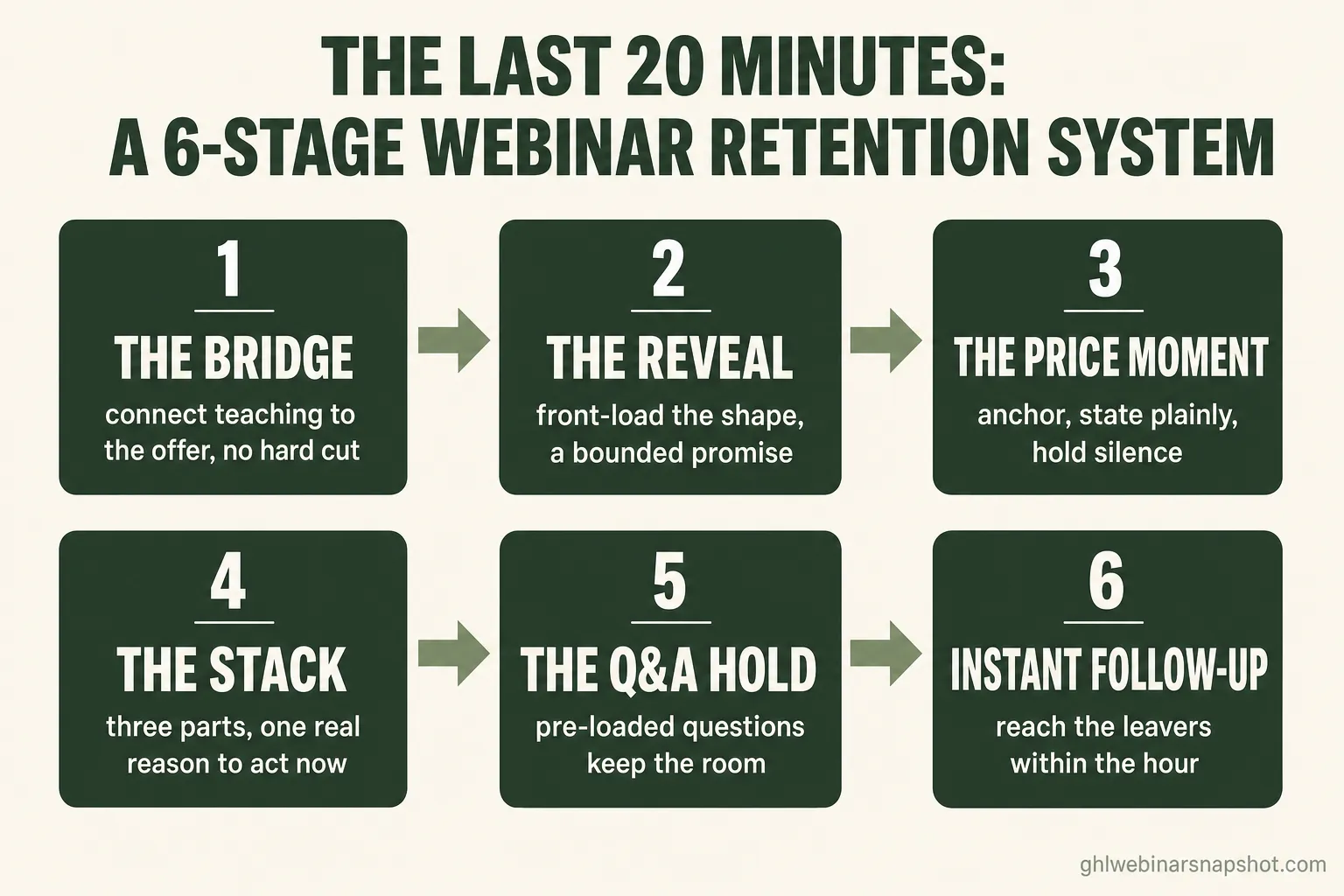
Stage 1: The bridge (the 90 seconds that matter most)
Why they drop: The most common mistake is a hard cut. You finish teaching, pause, and say “okay, so I want to tell you about something.” That sentence is a starting gun for the exit: it signals the value is done and a sale is coming, so the people not yet sold leave.
The fix: Bridge, do not cut. Connect what you just taught to what you sell so the offer reads as the logical next step. Keep teaching through the transition, framing the offer as “here is how to do everything I just showed you, faster,” never “now for the sales part.”
Steal this bridge:
“So that is the whole method. And if you are thinking ‘this is great, but building all of this myself will take weeks,’ you are right, it will. That is exactly the problem I kept running into, and why I put the entire thing together as a done-for-you system. Let me show you what that looks like, then I will answer everything in the chat.”
That names the objection before they think it, promises the Q&A is still coming so leaving means missing it, and never says “offer” or “pitch.” For how the bridge fits the whole path, see our playbook on booking sales calls from webinars.
How it breaks: If your teaching never surfaced a problem your offer solves, the bridge has nothing to stand on. Fix it upstream, in the content.
Stage 2: The reveal (structure so they stay)
Why they drop: People leave when they cannot tell how long the reveal will last or what is in it. Ambiguity reads as “this could go on forever,” and the exit is one click away.
The fix: Front-load the shape. Tell them exactly what you will cover and how long it takes, then deliver in that order. A bounded promise (“three things, about six minutes, then Q&A”) keeps people because they can see the finish line.
Steal this reveal open:
“I am going to cover three things: what is inside, who it is not for, and the two ways to get started. Give me about six minutes, then I am staying on for live questions.”
“Who it is not for” is the quiet workhorse. Disqualifying part of the room raises trust for everyone else and keeps the right people leaning in.
How it breaks: You overrun your own promise. Say six minutes and take fifteen and the audience learns your promises are soft, so the next cliff comes early. Rehearse it to time.
Stage 3: The price moment
Why they drop: The price reveal is the most feared moment for the presenter, so people rush it, mumble it, or bury it. Attendees feel the flinch and it makes them flinch. Others leave because the number arrived with no context and sounds like a lot.
The fix: Anchor it against the cost of the problem, state the number plainly, and hold silence. Do not apologize or discount on the spot.
Steal this price frame:
“Building this yourself is 40-plus hours, or a few thousand dollars if you hire it out, and you still have to maintain it. The system is a one-time investment, and you can see the number on the page. Same result, none of the build time. Here is exactly what you get.”
How it breaks: You discount live and unprompted. A price you cut the second you said it tells the room the first number was fake and teaches next time’s audience to wait you out.
Stage 4: The stack and honest scarcity
Why they drop: Two opposite failures. Either the offer is a flat single line with no reason to act now, so people leave to “think about it,” or it is a fake-countdown, ten-bonus circus that reads as a scam.
The fix: Build a short, legible stack, three components at most, each tied to an outcome, then give one real reason the timing matters. Real scarcity is a true enrollment window, a bonus that expires, or limited onboarding slots you can honor. If it is not true, do not say it.
Steal this stack close:
“So you get the system itself, the install done for you, and 30 days of support while you run your first webinar on it. The support window is the limited piece, I can only onboard a handful of people well each month, so if you want that hands-on help, this is the cohort to join.”
How it breaks: Fake urgency. A countdown timer that resets on refresh, or “only 3 left” on a digital product, is the fastest way to lose a skeptical B2B buyer.
Stage 5: The Q&A hold
Why they drop: Most presenters end the offer, say “any questions?”, and let dead air do the killing. Silence after the pitch feels like the end, so people leave, and you lose the fence-sitters who had one worry and no fast way to voice it.
The fix: The Q&A is the second half of the close and the best retention tool you have. Promise it before the pitch (stage 1 did this), then run it with pre-loaded questions so it never stalls. Answer the likely objections out loud even if no one asks: for every person who types one, ten are wondering it silently.
Steal this Q&A bridge: “While those come in, the question I get most is whether this works if you have never run a paid webinar before, so let me answer that first.” Then keep a running “last call” every few minutes that points back to the offer link.
How it breaks: You wing it and hit a lull, or get defensive on a hostile question. Prep five real questions and never argue with the room.
Stage 6: Instant follow-up for the ones who still left
Why it matters: Even with all five stages tight, some of your best buyers leave before the offer, and about half only ever engage with the replay. That is the shape of the audience, not failure, and the stage most operators skip is catching those people while they are still warm.
The fix: Tag behavior in real time and follow up fast. Someone who watched to minute 40 is a different lead from someone who left at minute 5, and the person who hit the offer link but did not buy is the hottest lead you have. Speed is the whole game: responding within an hour makes you nearly seven times more likely to qualify a lead, and more than 60 times more likely than waiting a day.
Steal this dropper follow-up (send within the hour):
“Hi [name], you were with us most of the way tonight but had to jump before the end. Here is the full replay, and the offer we covered so you do not have to hunt for it: [link]. If it is easier to just ask your questions live, grab any slot here: [calendar].”
How it breaks: You batch it. A follow-up that goes out the next day arrives after the intent has cooled and reads as a broadcast, and it breaks on compliance if it runs over SMS without consent. For the wider play, see the no-show recovery system and the 9-email webinar sequence.
Run it for three ticket bands
The same six stages, run for a $47 course, a $6,000 program, and a B2B demo, look different enough that copying the wrong version empties the room.
The low-ticket course seller ($27-$197)
Your buyer decides fast and cheaply, so a long, heavy close hurts you. Compress stages 2 through 4 into a few clean minutes, make the price a near-impulse (“less than dinner out”), and lean on a real, short enrollment window. Your biggest lever is not the live close but stage 6: at this price the replay and automated follow-up do most of the converting.
The high-ticket coaching seller ($2,000-$15,000)
Here the close is the event. Your buyer needs to feel the trust, so the bridge and the Q&A carry the weight. Spend real time on “who it is not for,” slow the price moment down, and expect the purchase to happen on a call, so the offer is often an application or booking rather than a checkout. Stage 6 is routing hand-raisers to your calendar within minutes, the attendee-to-consult motion these webinars live or die on.
The B2B demo (pipeline, not checkout)
Your “offer” is a next meeting, and your “drop-off” is a demo attendee going dark. The teaching is the product walk-through, the bridge moves from “here is what it does” to “here is what it would do for your team,” and the close is a specific, low-friction next step (“15 minutes with your ops lead to scope it”). Scarcity barely applies; trust and specificity do. Stage 6 is your CRM: tag who watched the pricing section and follow up while the demo is fresh, then prove which touch produced pipeline with multi-touch attribution.
The compliance line on your offer
Two places in this system quietly touch the law, and getting either wrong turns a good webinar into a liability.
First, the offer itself. If your close makes any claim about income or earnings (“students make an extra $10k a month”), you are in FTC territory. The FTC Business Opportunity Rule (16 CFR Part 437) requires earnings claims to be truthful and substantiated, with proof you can produce on request. A broader standalone earnings-claim rule was proposed by the FTC in a 2022 advance notice but was not final as of the last verified guidance, so re-check its status before building a close around one. The safe move is to sell the system and the outcome it enables, not a dollar figure you must defend.
Second, the follow-up. Stage 6 works best over SMS, which in the US is governed by the TCPA and A2P 10DLC: you need documented consent, a registered campaign, a clear opt-in on the registration form, and a working opt-out on every message. The penalties are per-message. We cover it in the webinar compliance guide; none of this is legal advice, so run your specifics past a qualified attorney.
Common objections, answered
“Won’t fixing the transition feel manipulative?” The opposite. The manipulative version is the hard cut plus fake countdown, and buyers smell it. A clean bridge is just good teaching: you connect what someone learned to the fastest way to act on it and tell the truth about price and scarcity. That honesty is what converts the skeptical buyer the circus repels.
“My show-up rate is the real problem, not the drop-off.” Both are real, and they compound. If half your registrants never show and half the rest leave before the offer, you are pitching a tiny fraction of the people you paid to acquire. A reminder cadence fills the room; fixing the transition keeps it full. See why show-up rate compounds.
“Do I need expensive software to build the follow-up part?” No. You need behavior tags, a fast trigger, and a place to send people. That is a workflow problem, not a platform problem, and exactly what a GoHighLevel build handles without a five-figure enterprise contract. What matters is that the leaver gets a relevant message inside the hour. If you run evergreen, stage 6 is nearly your whole game: you automate the bridge, reveal timing, and follow-up instead of performing them live.
FAQ
Why do webinar attendees leave right before the offer?
Mostly because the presenter signals the switch from teaching to selling with a hard cut, a change in tone, and an offer slide, which reads as permission to leave. The drop is structural, not a reaction to price, since most people leave before they hear the number. Bridging smoothly into the offer and promising a live Q&A afterward keeps the room in place.
What percentage of webinar attendees stay until the end?
It varies, but the average attendee watches only about 26 minutes of a 68-minute session according to Livestorm's 2026 Webinar Benchmark Report, so a large share are gone before an offer that lands at minute 45 to 50. Planning your close as if the whole room is still watching live is the core mistake.
When should I make the offer in a webinar?
Earlier than most people do, and as a continuation of the teaching rather than a separate section. Instead of teaching 50 minutes and pitching to a half-empty room, weave the bridge in while attendance is high and keep a Q&A running after the offer. The exact minute matters less than removing the visible seam between content and pitch.
How do I follow up with people who left before the offer?
Tag them by how far they watched and follow up within the hour with the replay plus a direct link to the offer and your calendar. Responding within an hour makes you nearly seven times more likely to qualify a lead than waiting even an hour longer, per Harvard Business Review research. Over SMS you need documented consent and a registered A2P 10DLC campaign first.
Does the offer sequence change for low-ticket versus high-ticket?
Yes. A low-ticket course needs a short, near-impulse close and leans on the replay and automated follow-up. A high-ticket coaching offer needs a slower close built on trust and Q&A, and usually converts on a call. A B2B demo replaces the sale with a booked next meeting. Copying the wrong sequence for your price point is a common reason the room empties.
Related reading
- The Webinar Conversion Funnel: Every Stage From Ad to Booked Call
- How to Book Sales Calls From Webinars: The Attendee-to-Consult Playbook
- Webinar No-Show Recovery: Win Back the Registrants Who Didn’t Attend
- The Webinar Email Sequence: The 9-Email Cadence That Fills the Room
- Why Show-Up Rate Is the Only Webinar Metric That Actually Compounds
- Webinar Compliance in 2026: The 5 Laws That Can Bite You